After ENWYC, several families went up to the Dr. Ralph L. Buice, Jr. Observatory. We had a chance to see Saturn, the moon, and Algieba.
Algieba is a double star in the constellation Leo. Algieba means the lion's mane.
Steve Bieger was our guide for the evening. Steve has a blog at http://ceastronomy.org/sbieger/.
Thanks Steve for guiding us through the sky.
Sunday, June 23, 2013

Saturday, June 22, 2013
Show and Tell Photos from 062013
The bearded dragon eats about 3 dozen crickets. He likes squash and doesn't like pepper. We did find out they do bite. So you should always use care when opening it's mouth to show it's teeth.
 |
| Bearded Dragon |
This little guy didn't get his time until the end of class when most of the kids were out playing or had already left for the evening.
 |
| Cricket |
Friday, June 21, 2013
A Big Thanks To Our Guest Beekeeper
Last night's class was a big hit. Terry Wierman came in for a special session on honey bees. Both children and parents enjoyed the evening.
The evening started out with a show and tell. The evening finds included a black cricket, bearded dragon, leaves, squash bug larvae, and red aphids.
The children then started coloring different bee pages as Terry started to talk. He passed around a piece of honeycomb. It was amazingly light. The goal is to build the most structure with the least amount of material.

Terry showed us a bee hive box with frames, beekeeping suit, and smoker. These are just some of the essential tools of a beekeeper. The suit would be a good protection from mosquitoes. The only problem is that it gets a bit hot inside the suit.


The evening started out with a show and tell. The evening finds included a black cricket, bearded dragon, leaves, squash bug larvae, and red aphids.
The children then started coloring different bee pages as Terry started to talk. He passed around a piece of honeycomb. It was amazingly light. The goal is to build the most structure with the least amount of material.

Terry showed us a bee hive box with frames, beekeeping suit, and smoker. These are just some of the essential tools of a beekeeper. The suit would be a good protection from mosquitoes. The only problem is that it gets a bit hot inside the suit.


Beekeepers harvest honey in the summer. In the spring, they check the hive to make sure there is enough room to grow the hive. Honey can be harvested as long as the bees are there.
Next, we built our happy hive, learning about the different types of bees and stages of bees as we went.

We learned about the three types of bees: queen, drone, and worker.

The queen has a long pointy abdomen. She has a retinue of workers around her. Her job is to produce eggs. She only flies to mate or swarm.
The drone is a male bee. He doesn't have a stinger. Drones die when they mate.
The worker goes through a cyle of jobs. Her first job is to clean her own cell since the cells are reused. She then feeds her sisters in the cells next door. She does this from glands in her head. Some other jobs that she will do while she is developing include builder bee, fanning bee, and guard bee. The builder bee builds more honeycomb to make the hive bigger. The fanning bee moves air to dry the nectar and cool the hive. The guard bee is stationed near the entrance of the hive and protects it from danger and attack. If a bee isn't bringing anything into the hive, then this bee is considered dangerous. Some bees actually steal the honey from other bee hives. The guard bee will fight with other bees as a defense. When a worker bee is more mature, she becomes a forager bee. She brings in pollen, nectar, and water.
Pollen is used by the bees as a protein source. Bees will visit only one kind of flower on a trip. This is how they pollinate.
Honeybees are the only bees that lose their stingers because the stinger has a barb at the end. They only sting to protect the hive. They don't want to sting you.
We also had a chance to taste four different types of honey. Some of us loved the experience, others found the honey not as enjoyable. But we all enjoyed trying it out.
To finish off the evening, we visited the hive exhibit. Here, Terry pointed out the different types of bees, cells, and activities going on.

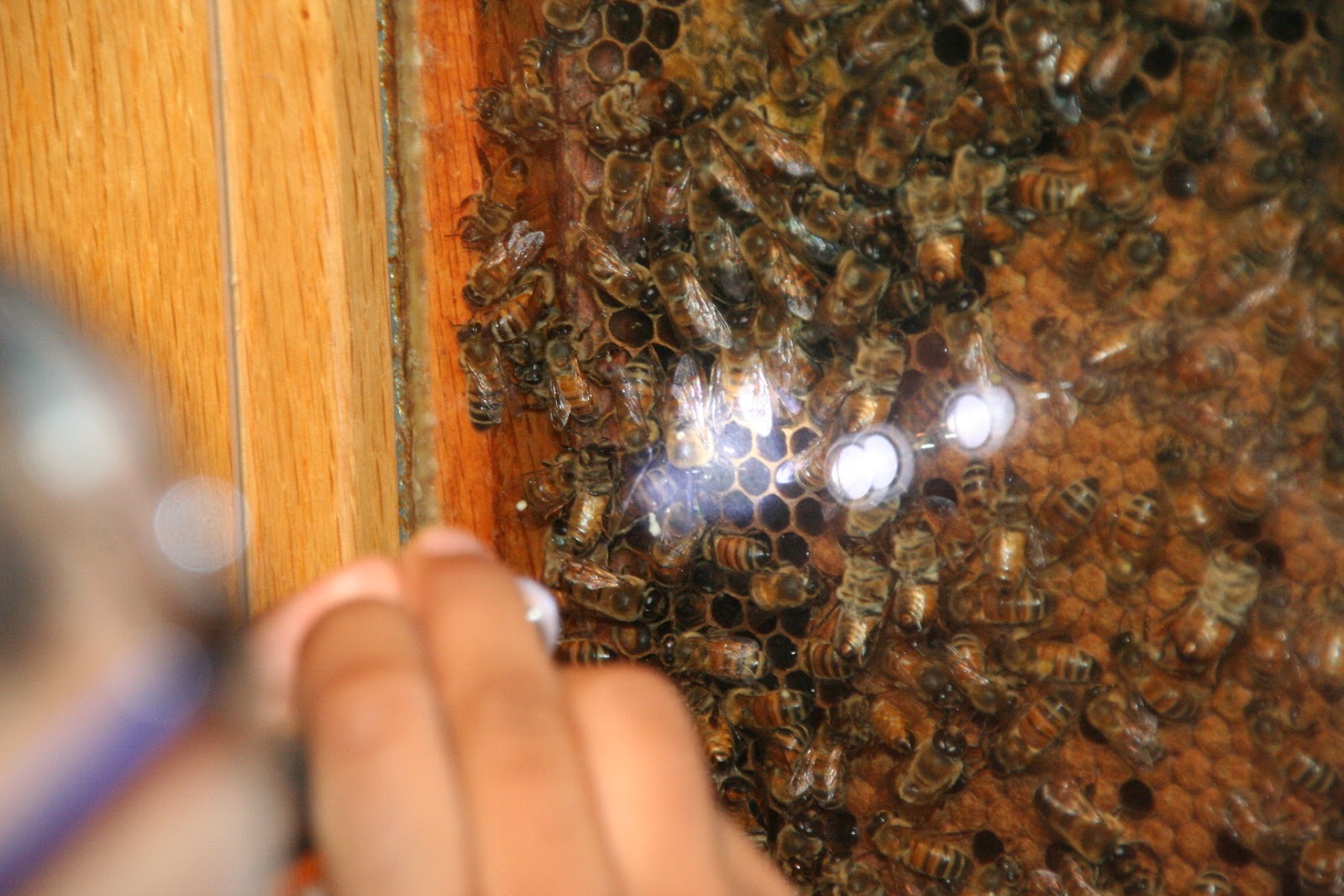
The highlight was when we found the queen. It brought us back for a final look.
Thank you Terry for sharing your knowledge and involving us all in the learning.
Thursday, June 20, 2013
Guest Beekeeper tonight
Tonight is our guest beekeeper. We are looking forward to Terry Wierman's visit.
Wednesday, June 19, 2013
In honor of tomorrow's guest
Honey Bees
N P I D B U R R S A N H J N A
B X O I F P A M J O D A S X E
T Q C J L M R Q I U J N O J X
E X U R A A C T U D K C F C L
K E V E W D A Z A E V I H H A
E A R S E N H N O G S G Q I H
Z X M Z I N C J N W Q H O L I
R T P L B E E K E E P E R D W
I A L L S U F D L P R R V R U
V O T B O H W E L L I C O E E
P W E C X R F H O N E Y F N U
C E Z F E D I E P Q A X O U N
S F A L N N P N A K P D P Q X
W E R U T A N T G D I R Y P T
P B Z S P Q S L Z E S I C T X
APIS
BEEKEEPER
BEES
CHILDREN
DANCES
EXPLORING
HIVE
HONEY
NATURE
NECTAR
POLLEN
POLLINATION
QUEEN
SWARMS
Tuesday, June 18, 2013
Monday, June 17, 2013
Rabbit skull
On 6/13/13, someone brought in a skull to ENWYC. The skull was from a small rabbit maybe about 4 months old. We learned how the rabbit tears grass with it's sharp front teeth. The scissor like motion cleanly cuts the blade. It was cool seeing where the brain and eyes were suppose to go.
 |
| Rabbit Skull Photo by Lynne Clark |
 |
| Rabbit skull Photo by Lynne Clark |
 |
| Rabbit skull Photo by Lynne Clark |
Sunday, June 16, 2013
6/13/13 Class recap
ENWYC started with a missing creature and ended with a bang.
We started with a find the creature in a bucket full of sand, water, and seaweed. This proved impossible with the theory being that the cat ate "my show and tell". Next, a bug turned up missing. This one must have slipped out of the container on the walk to the classroom.
Even though things started out slowly. The excitement built. Al brought in some finds of his own a trans-section of a periwinkle shell, a giant heart cockle shell, a paper wasp nest, and more.
We also had a visit from a Fowler's Toad. This toad excretes bufonin, which is a viscous white substance that is toxic. It is very important to wash one's hands after handling this toad. It can cause irritation especially to the eyes and mouth. When a predator trys to eat a Fowler's Toad, the toad releases the bufonin. This makes the predator throw up the toad.
During class, some of the toad's skin was shed. This is a normal process.
Toads and frogs have a specialized tongue to catch their prey. Al gently used a probe to open up the toad's mouth and uncurl the tongue. Below are some photos of this.

We started with a find the creature in a bucket full of sand, water, and seaweed. This proved impossible with the theory being that the cat ate "my show and tell". Next, a bug turned up missing. This one must have slipped out of the container on the walk to the classroom.
Even though things started out slowly. The excitement built. Al brought in some finds of his own a trans-section of a periwinkle shell, a giant heart cockle shell, a paper wasp nest, and more.
 |
| Fowler's Toad Photo by Lynne Clark |
During class, some of the toad's skin was shed. This is a normal process.
Toads and frogs have a specialized tongue to catch their prey. Al gently used a probe to open up the toad's mouth and uncurl the tongue. Below are some photos of this.
 |
| Uncurling the Tongue Photo by Lynne Clark |
Someone else brought in a rabbit skull. More on this in tomorrow's post.
As we were putting up the microscopes and cleaning the room, a thunderstorm rolled in and the weather siren went off. We waited out the rain, thunder, and lightning in the hall before heading home.
Saturday, June 15, 2013
Name that Snake?
This snake was found in a friend's yard. Al was able to identify the snake. It is a Agkistrodon contortrix better known as the venomous "copperhead". It looks to be a well-fed adult male.
 |
| Copperhead Photo by Timi D |
Friday, June 14, 2013
Guest beekeeper at next class
Next week, Terry Wierman will be teaching us about honey bees. Terry is a designer and beekeeping enthusiast at Fernbank Science Center. He is planning on showing us the bee hive exhibit inside the center and more. He may even bring his beekeeping suit.
This strange contraption can be found up in the trees near the bee hive. Terry will be able to tell us what it is.
Terry's visit will be a special treat for us all.
The next class is Thursday, June 20, 2013. We hope to see you there.
 |
Terry's visit will be a special treat for us all.
The next class is Thursday, June 20, 2013. We hope to see you there.
Thursday, June 13, 2013
Class is tonight!
Last week, we examined some different types of frogs, a spider, a wren's nest and egg, a crayfish, and more. We also spent some time at the pond catching mosquitofish.
What will tonight's adventure bring!
We hope to see you soon!
What will tonight's adventure bring!
We hope to see you soon!
Wednesday, June 12, 2013
Let's Sign Bug
"I've got bugs." was the quote from last week's class. In honor of bugs, take a look at Signing Times' sign of the week in April.
http://www.signingtime.com/blog/2013/04/sign-of-the-week-bug/
http://www.signingtime.com/blog/2013/04/sign-of-the-week-bug/
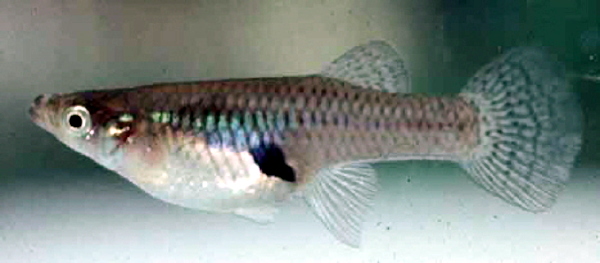
Mosquitofish
Size
- Females can grow up to 2.8 inches
- Males can grow up to 1.6 inches
Diet
- Insect larvae including mosquito larvae (This fact alone makes them specialn.)
- Algae
Special notes
- Great for water gardens
- Freshwater fish
- Live-bearing
Species
- Gambusia affinis
Tuesday, June 11, 2013
More about Roadside Geology of Georgia
 Who among us has not picked up a rock to study it a bit closer?
 Well then, Roadside Geology of Georgia might just be the book for you. It is written by Pamela J.W. Gore and William Witherspoon. Dr. Witherspoon is an instructor at Fernbank Science Center. He specializes in geology.
If you missed Rock Fest or you want more information, go to http://georgiarocks.us/. If you want to find out about upcoming events, like Roadside Geology of Georgia's Facebook page https://www.facebook.com/#!/RoadsideGeologyGA?fref=ts
Monday, June 10, 2013
Show and Tell
Here are just some of our Show and Tell nature finds.
 |
| One Large Spider Photo / Damon Young |
 |
| From The Pond: Interesting organisms to see under the microscope Photo / Damon Young |
 |
| A Hermit Crab Visits February 2, 2013 Photo / Lynne Clark |
 |
| Patent-Leather Beetle February 2, 2013 Photo / Lynne |
Sunday, June 9, 2013
ENWYC visits Rock Fest
On May 30, 2013, ENWYC went to Rock Fest for a special outing. This event
was held at Fernbank Science Center and was held in honor of the book release –
Roadside Geology of Georgia.
The event included a rock id session. We found out that not all rocks are
actually rocks. Sometimes, they are minerals. For example, the beautiful
quartz that one of the children brought in is actually a mineral. I’m not sure
Dr. Bill Witherspoon convinced him that it was not a rock, but, some of us
learned the lesson. We also had rocks mixed with minerals.
There were also several exhibits throughout the Fernbank Science Center.
Several were hands-on. Getting a chance to hold a dinosaur bone was quite
cool. The section was from the leg bone of a T-Rex. It was a huge highlight.

Another highlight was selecting a treasure for their own collection. One
of the exhibitors was kind enough to set up a tray of rocks, minerals, and
fossils for the children to pick a treasure to take home. Some of the
selections included quartz crystals, sharks teeth, manatee bone, and agate.
We played a game Where’s Archimedes? Can you find Archimedes?

Hint: It has a screw shape. There are several in the rock above. There
were other types of fossils inside.
Also included in the fossil section were Trilobite fossils such as the one
seen below.

The evening ended with a book talk and book signing. Both authors, Pamela J.W. Gore and William Witherspoon shared some interesting tidbits. Roadside Geology of Georgia is written for everyone to enjoy.
Saturday, June 8, 2013
Saturday, August 11, 2012
Wednesday, August 8, 2012
Fall Classes
Even though Fernbank Science Center's upheaval had led to a pause in classes. ENWYC will resume on Thusday, September, 6, 2012. Hope to see you there! :)
Monday, December 5, 2011
New Posts Coming Soon!
Hi parents and students of ENWYC,
Sorry there has been a lack of posts recently. Not to worry though, there should be some new pictures and post coming soon!
Sorry there has been a lack of posts recently. Not to worry though, there should be some new pictures and post coming soon!
Subscribe to:
Posts (Atom)